Here are the global nominees for NASA Space Apps Challenge 2017 and they need your voting support!

We are very happy to anounce our two Space Apps Stuttgart 2017 winning projects Tunnel-God-Detector and Whata. And Whata needs your voting support for the People’s Choice Award of the world’s biggest global hackathon!

(go to the voting page daily, search for “Whata”, Click on “vote” and hold it until it says “voted”, that’s it, thank you! :) )

During last weekend’s NASA hackathon, those two teams worked on solving global problems under this year’s theme “Earh Observation”. They tackled two different challenges and came up with excellent open-source solutions utilizing space data and create something new to help people. They both earned the global nominations and we wish them good luck in the final round where they compete against more than 1000 projects created by 20,000 people.

Please consider voting for Whata starting from 8th until 21th of May because each daily vote counts! If you like, join their teams and work together on their open-source projects.

The Whata team worked on “Where’s the Water?” to use satellite and other data to allow farmers, landowners, and land managers in your locale to identify and visualize water resources in their surroundings. They’d like to help people find reliable water sources. They came up with providing the means with low-cost, easy-to-fabricate sensors, open-data, and existing govermental data.

[embed]https://www.youtube.com/watch?v=vZr-N3Hpri8[/embed]

The Tunnel-God-Detector team had a personal twist on the “When Landslides Strike” challange, that originally aimed about teams designing an easy-to-use tool to allow the public to discover and understand landslide data, and to contribute their own observations for use by emergency managers. They selected this challenge and and adapted it to a very shackspatial eperience. In shackspace, you reguarly feel tremors caused by targeted detonations to the S21 tunnel construction site. So they came up with this awesome idea to detect and locate the origin of tremors. And while discussing the idea, another (virtually present) team member’s experience about an earth quake she felt in Skopje, Macedonia in December 2016 made them work on creating those sensors. In this way, they want to support emergency teams respond faster and save more people.

[embed]https://www.youtube.com/watch?v=AA3kHV6cgE8[/embed]

All 20 peope had fun during those 2 days and it showed, how much creativity is in everyone of us. We will definetively try to bring back the NASA Space Apps Challenge in 2018!

Thank you to everyone and we will keep you updated about the nominees.

IOT für Einsteiger: SMD löten + ESP8266 prototyping hands-on workshop

Update:

tl;dr: alle, die im Doodle den 20. Mai bestätigt haben sind dabei.

Ausführliche Version:
Nach dem etwas chaotischen Umplanen des IOT Workshops wird am 20. Mai wird der IOT Workshop in Optionsraum 2 statt finden.

Folgende Teilnehmer haben ihren Platz fest:

  • Erik
  • Denis D.
  • Arno
  • Daniel Z.
  • swim
  • Konrad
  • Domyos
  • Mike Ernst
  • myriam
  • Dominic SBeginn des Workshops ist 15:00 , bitte 15 Minuten vorher da sein ;)
    Location ist der shack e.V. : https://blog.shackspace.de/?page_id=713Es wird ein Laptop mit arduino IDE wird benötigt, der rest wird gestellt.
    Unkosten sind 10 Euren (bar).Folgender Link beinhaltet die Workshop Steps und source code: https://github.com/makefu/esp-workshop

IOT für Einsteiger: SMD löten + ESP8266 prototyping hands-on workshop

Datum: Samstag 20.Mai oder 10.Juni 15-18 Uhr

10 Teilnehmer

tl;dr: Der IOT workshop muss leider verschoben werden, Teilnahme bitte updaten: Doodle IOT Termin

Ziel: Befähigung erlangen, einen ESP8266 (wifi mini computer … IOT ‘n stuff) zu programmieren, selbst gelöteten ESP mit RGB-LED + USB-Seriell für weiteres hacken mitnehmen.

P: “IOT? Niemals gehört!”
A: “Unter welchem Stein lebst du denn?!”

Man kann damit schöne bunte Würfel bauen 1

oder aber sein Haus “intelligent machen” 2

https://youtu.be/UcO_PS7-kX8

Agenda

  • Vorstellungsrunde: Wer bist du? Warum elektro-Internet-Kleingeräte? (aka IOT)
  • Schnelle Einführung in Elektronik Prototyping

    • Spannung, Widerstand und Ampere?!
    • IO pins, Wo muss man aufpassen, lessons learned
    • USB-Serial
  • 30 min SMD löten: Hands-on Workshop (Einsteiger-level)

    • a USB-Serial Kabel “hacken” damit es richtige 5V liefert
    • Löte den ESP8266 an das PCB Adapter-Board
    • Spannungsregler, ws2812b (RGB led mit Microcontroller), Stecker, Gewürze
  • Einführung Arduino IDE + hands-on

    • “blinke-led” für IOT (Web-Server im WLAN)
  • Schnelle Einführung: NodeMCU (LUA) + hands -on

    • wlan setup
    • find your box (e.g. mybox.connector.one)
    • control rgb led from your smartphone
  • happy hacking, social, Pizza?

Die Agenda wird ggfs. kurzfristig angepasst.

Unkostenbeitrag 10€ p.P. für das super Esp8266-Dev-Set, das Ihr zum weiter hacken mit nach Hause nehmen müsst.

Von den Teilnehmern vorzubereiten:

Organisation, Ausführung: exco, makefu

World Create Day 2017 im shackspace am 22. April


Hackaday, die große Maker-Gemeinschaft, veranstaltet am 22. April den World Create Day, an dem Hackerspaces rund um die Welt gemeinsam hacken – und shackspace wird dabei sein!

Ab 11 Uhr morgens ist der shack offen für alle, die ihre Projekte mitbringen und gemeinsam mit uns basteln wollen, und es wird gehackt, bis der Arzt kommt!

Der einzige Programmpunkt ist eine Show-And-Tell-Session um 19:00 Uhr im Seminarraum, bei der alle die Möglichkeit haben, ihre Projekte kurz vorzustellen und damit Stoff für weiterführende Unterhaltungen zu liefern.

Für diese wird es im Anschluss genug Gelegenheit geben, denn es kann bis in die Nacht weiter gebastelt werden oder man verquatscht sich bei leiser Hintergrundmusik und loungiger Atmosphäre über Projekte.

Wir hoffen auf zahlreiches Erscheinen und interessante Basteleien!

Zum Event:
Eintritt frei! (Spenden an shack e.V. sind gerne gesehen) Jeder ist willkommen!
Datum: Samstag, 22. April 2017 ab 11:00 Uhr
Anfahrt: U4/U9 Haltestelle “Im Degen”, Ulmer Straße 255, Stuttgart Wangen (gegenüber Kulturhaus Arena)

NASA Space Apps Challenge Stuttgart 2017

For the fourth time, the NASA Space Apps hackathon weekend returns to Stuttgart! Sign up now to participate in the biggest hackathon event on this planet (29. & 30. April 2017). Stuttgart is one of the biggest and most important aerospace regions in Germany and we are very proud to grow and support the local space industry and startup scene with this open-source space event for everyone!

[embed]https://www.youtube.com/watch?v=AtgGzsYLNig&index=1&list=PL-lXf3kTWgqwtoRVGs5Hs0qIuWWeR7X5Y[/embed]

Space Apps is an international hackathon that occurs over 48 hours in cities around the world. Because of citizens like you, we continue to grow each year. If you haven’t already, join us to share ideas and engage with open data to address real-world problems, on Earth and in space. Work alone or with a team to solve challenges that could help change the world. And everybody can help, diverse backgrounds (software developers, engineers, artists, journalists, hackers, makers,…) will provide unique solutions to global problems that nobody thought about before. Check back here to join Space Apps in the Stuttgart hackerspace shackspace.

Space Apps Stuttgart 2017 Hackathon Weekend (29/30.04.2017):

  • start 29.04.2017 opening 11:00 CEST, launching event 13:00 CEST, coming later is okay
  • end 30.04.2017 18:00 CEST
  • in shackspace, Stuttgarter Hackerspace (Ulmer Str. 255, Stuttgart-Wangen)
  • next to subway station “Im Degen” (U4/9) (https://goo.gl/maps/yvdvw4tCUY22)
  • no fees, (donations are welcome).
  • everybody is kindly invited to hack for space! Register on Meetup or SpaceAppsChallenge.org

The registration is open via Meetup.com and SpaceAppsChallenge.org. We will also have data bootcamps before the hackathon weekend. Meet other space enthusiasts there and start your space project early. We have a limited amount of places, so please be fast and register your slot today!

Last years, our project BigWhoop (2015) and Cress.Space (2016) were selected #7 out of 900 projects for the Global People’s Choice Awards and and amoung the top #25 of the Global Award Finals. This year, we want to top this again, with you! This year’s challenges are about Earth and Earth Observation. More Details will follow soon.

Space Apps Stuttgart is kindly supported by the Stuttgart chapter of the Deutsche Gesellschaft für Luft- und Raumfahrt (DGLR), shackspace hackerspace and AerospaceResearch.net. Our projects were also presented during the International Astronautical Congress 2015 in Jerusalem and other space conferences.

More information will follow, so please check our webpages frequently for further news.

Still no clue? Fear not, we will have at least one pre-event called Data Bootcamp when we will meet already and discuss the projects we could work on. Everybody can do space, even you! We are waiting for you.

Space Apps Stuttgart 2017 Data Bootcamp Weekend (Weekends before):

  • At least one Weekend before Space Apps Hackathon Weekend, 08.04.2017 and 24.04.2017
  • Perhaps more, if you like it.
  • start 19:00 CEST, open ending
  • in shackspace, Stuttgarter Hackerspace (Ulmer Str. 255, Stuttgart-Wangen)
  • no strings attached. Just come, meet space enthusiasts, discuss, start your project early.
  • Please register on Meetup or SpaceAppsChallenge.org, too
    Find out more

here 2017.spaceappschallenge.org/locations/stuttgart
Follow us on twitter.com/SpaceAppsStgt
Like us on Facebook facebook.com/SpaceAppsStuttgart

Contact at spaceapps@aerospaceresearch.net (interested in joining the local organizing event team?)

Event Information

Please don’t park on the parkin slots in front of the hackerspace! you will be towed away, unfortunately :(

Schedule

Friday (optional)

  • 19:00 - Pre Event - come as you are. Checkout the hackerspace, meet people, have fun!
    Saturday

  • 11:00 - Open

  • 13:00 - SpaceApps Stuttgart Start
  • 14:00 - Hacking time
  • 21:00 - Midway demos
  • 22:00 - Dinner
  • 23:00 - Night Hack Session
    Sunday

  • 09:00 - Breakfast

  • 10:00 - Hacking time
  • 13:00 - Lunch
  • 14:00 - Hacking time
  • 18:00 - Closing demos
  • 20:00 - End Party
    After Monday

  • Your app has just started! Prepare for the jury selection (videos, webpage, etc…)

Space ... the final frontier

Have you ever dreamt of going to space?! At least as a child you did.

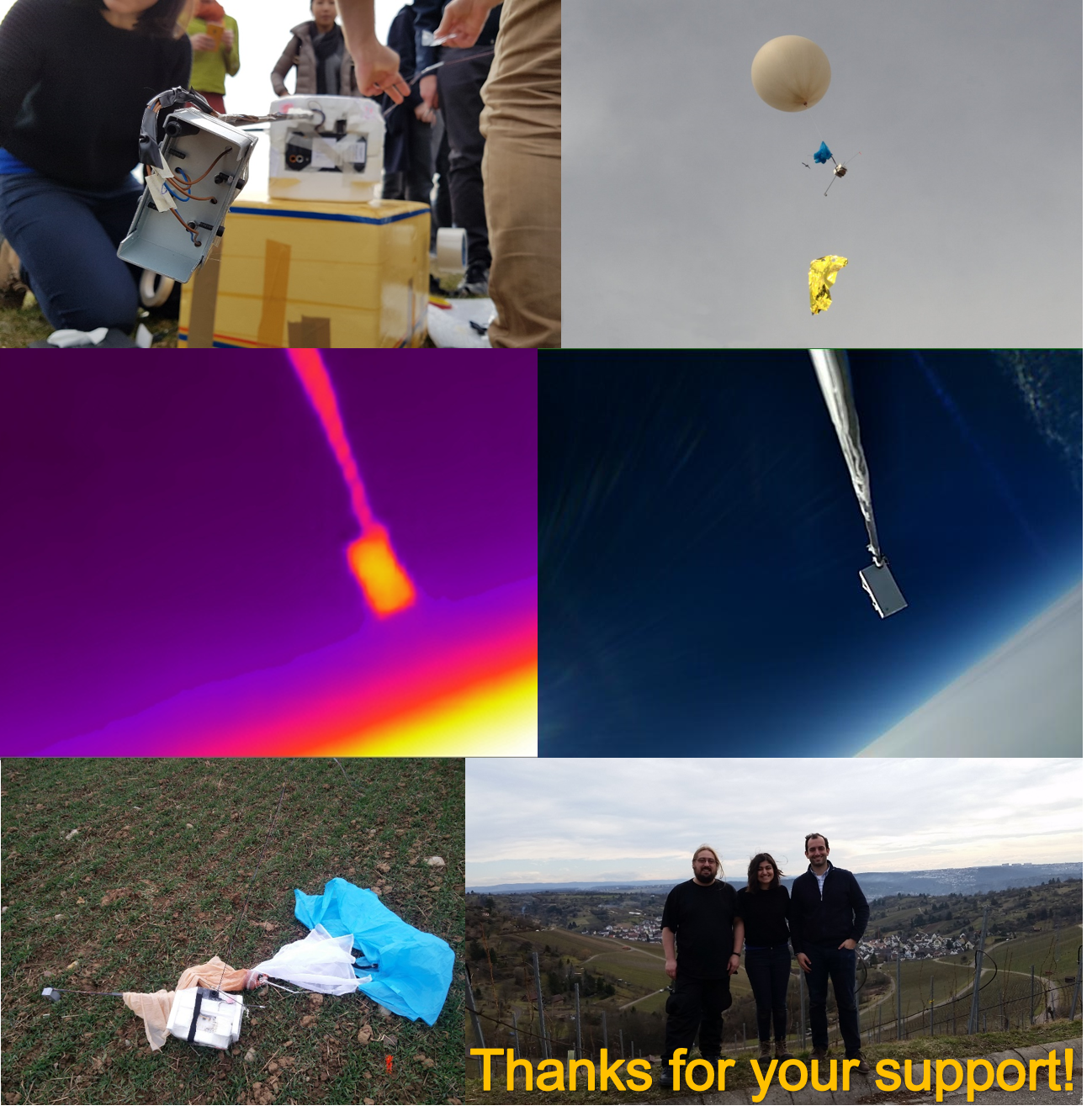
Unfortunately we didn’t quite make it to space ~100km quite yet - but at >22km we (our balloon that is) have been higher than at least 99.99% of you out there. Commercial airplanes fly at 8.5km to 10.7km to give you something graspable to compare it to.

Ever since we saw the first footage of a camera attached to a weather balloon we became fascinated by the idea to take our own images. The visible curvature of our small sphere (speak: earth) floating through space captured was ever so inspiring. You don’t even need to spend a lot of money doing so.

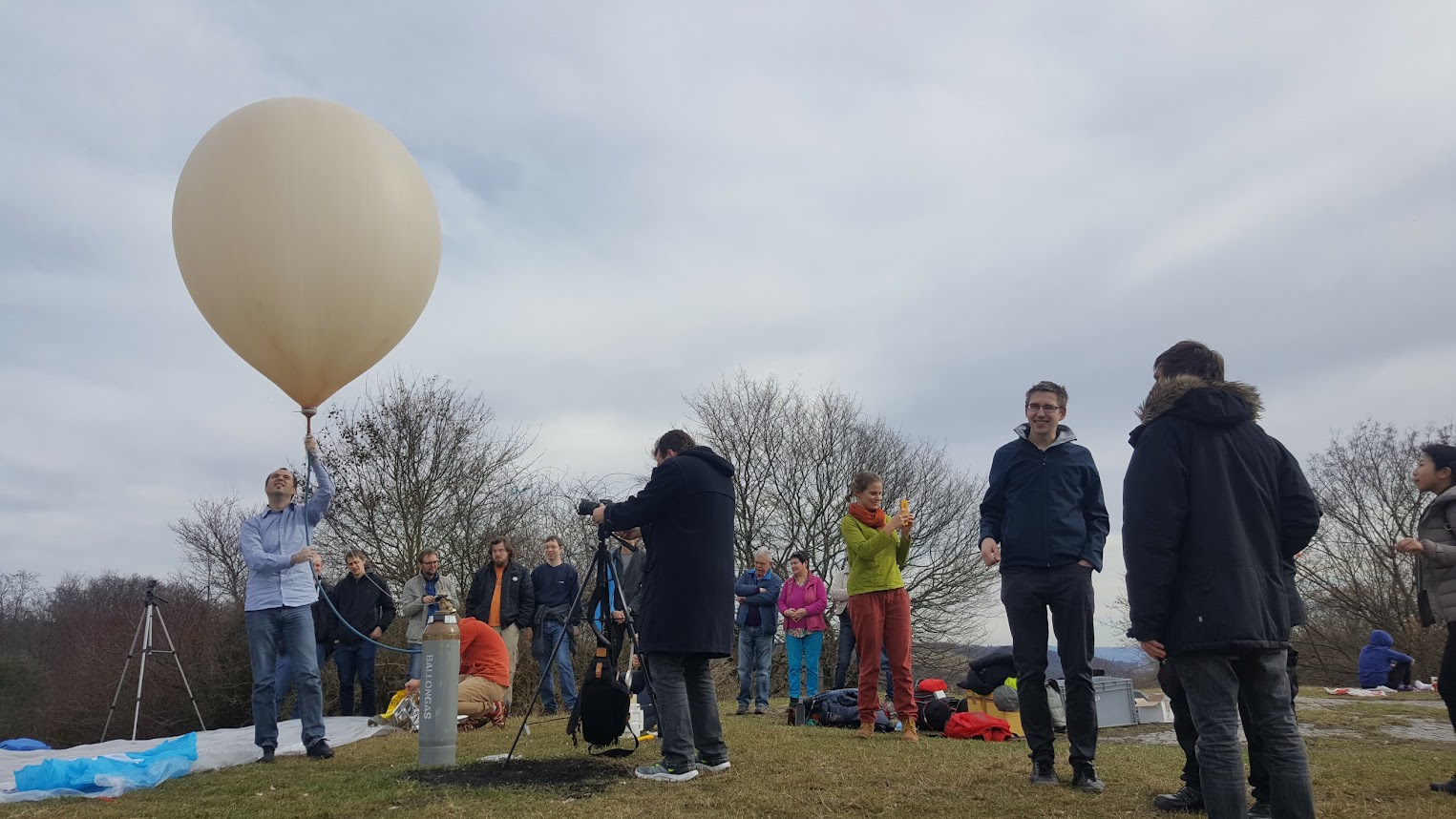
The project dubbed “spaceballoon” was accomplished by the team (andreashornig, exco, makefu) collaborating at our local hackerspace - the shack. On Saturday, 4.3.2017 we successfully launched it from the nearby Grillplatz Rotenberg on top of the Württemberg mountain.

The launch was exciting - even more so because we had more than 10 people waiting for us on the hill we chose for takeoff.

Here is a visualization attempt of the logged data:

Nadka made an awesome video with the onboard footage and with some material that was taken by someone at the launch site.

This is the flight path from one of the onboard android phones:

The “hunt” for the balloon was thrilling as we lost contact with our transmitter multiple times.
Through interpolation and some luck picking up the signal again we were able to pickup the payload - even though the commercial tracker and the android phone didn’t tell us their location - or anything for that matter.

We are also really happy that the last minute efforts of team Bremen bore fruits.

[embed]https://www.youtube.com/watch?v=niP5QITBaEE[/embed]

As people are already telling us they also have plans (for a long time) to start a weather balloon of their own - here you can show your hands if you want to be the / a part of the next balloon project. You find a lot of needful things on our Github Repository.

A big and unorganized spaceballoon photo album can be found here.

Special thanks to Andreas (http://aerospaceresearch.net/) for taking the initiative thus causing the project to finally happen and to exco (http://excogitation.de) for sourcing the necessary parts and hacking together the whole thing into the final product.
For the lessons learned we wrote you the weather balloon guide.

Reminder: writing it down makes it science - so document your projects.

Find more on our twitter account for the spaceballoon.

Einweihung des Weltenraum und Vortrag mit Hands-on Workshop zum Amateurfunk-TV

Zur Einweihung des Weltenraumes, unserem neuen Medialab, Funkraum und Mehrzweckraum im shack, bringen wir euch das erste Event zum Thema Amateurfunk am 25. Februar 2017 ab 17:00 Uhr . Und zur weiteren Feier des Tages werden wir Tschunk-Cocktails im Weltenraum ausgeben.

Jeder kennt Fernsehen. Aber wusstet ihr, dass auch jeder Fernsehen machen darf und kann? Michael vom Backnanger Ortsverband des Amateurfunkvereins DARC e.V. wird euch in die Welt des Amateurfunk-Fernsehens (ATV) einführen.

Es wird einen Talk und anschließenden Hands-on Workshop geben, bei dem ihr ins Thema eingeführt werdet…

Einweihung Weltenraum (17:00)

  • Kleine Führung im Weltenraum
  • Tschunk-Cocktails an die Gäste und Bauhelfer (solange Vorrat reicht)
    Talk (ab 17:30):

  • Einführung: Was ist Amateurfunk, wie wird man Funkamateur, was darf/kann man als Funkamateur machen?

  • Grundlagen: Was ist ATV, was ist D-ATV?
  • Grundlagen: Die verschiedenen Betriebsarten DVB-C/S/T und ihre Eigenschaften
  • Systemaufbau: Die notwendige Ausrüstung, Hardware-Lösung vs. SDR-Lösung
    Hands-on Workshop (ab 18:00):

  • D-ATV am Beispiel von DVB-T

  • Livevorführung mit einem BladeRF als Sender und einem handelsüblichen DVB-T-Stick als Empfänger. Also Webcam, Linuxserver, BladeRF als Sender und ein 10$ DVB-T-Stick am Rechner als Empfänger, das wars.
    Zum Event:

  • Zeit: 25. Februar 2017 (Sa), 17:00 - 19:00 Uhr

  • Ort: shackspace, Seminarraum und Weltenraum
  • Teilnehmer: jeder
  • Mitbringen: Lust. Eine kleine Menge an DVB-T Dongles kann gestellt werden.
  • Bitte trage euch unverbindlich in dieses Doodle ein.

Spaceballoon, will finally travel!

(English translation below)

Wir laden ein zum gemeinsamen Start Spaceballoon am 4. März 2017 (Sa) ab 09:00 Uhr auf dem Rotenberg in Stuttgart.

Die Projektziele:

  • Video der Erdkrümmung über Baden-Württemberg
  • Funkortungstest für das DGSN Projekt
  • Umgebungsdaten aufzeichnen
    • dein Projekt -
      Wenn du bereits eine “Nutzlast” hast, dann bringt diese zum Treffen am Integrationswochenende vor dem Start mit. Der Spaceballoon wird so zu deiner Plattform und nimmt dein Projekt mit auf seiner Reise. Falls du nicht live dabei sein kannst, verfolge den Ballon per Funk auf 869.525 MHz und hilf uns beim wiederfinden der gelandeten Nutzlast.

[embed]https://www.youtube.com/watch?v=VJ6p-FgIUkU[/embed]

(Unser Vorbild: How to send a weather balloon into space -Brent Thomas)

Wir vergeben den Platz an Bord per “First come, first serve”. Melde dich mit deinem Projekt bitte im Vorfeld per Email (spaceballoon(at)aerospaceresearch.net).
Zum entspannten Ausklang des Tages werden wir uns im shackspace treffen.

Sei dabei wenn der Spaceballoon startet und die Reise in den nahen Weltraum antritt.

Wir freuen uns auf euch!

Zum Event:

  • Start: 4. März 2017 (Sa), 09:00 - 12:00 mit anschließender Fuchsjagd
  • Abschluss: 4. März 2017 (Sa), 18:00 Führung und entspannter Ausklang im shack e.V.
  • Startplatz: Rotenberg Grillplatz, Karl-Münchinger-Weg 1, 70329 Stuttgart
  • GEO: 48.7844556N, 9.285263900000018O, http://w3w.co/letters.groomed.donation
  • Jeder ist willkommen!

Für Mitspieler:

  • 2017-02-25 20:00 - Vorabtreffen zur Nutzlast-Integration im shack
  • 2017-03-04 09:00 - Treffen am Startplatz auf dem Rotenberg
  • 2017-03-04 11:00 - Start der Ballonjagd. Auf 869.525 MHz wird die Ballontelemetrie gesendet.
    Wer die Möglichkeit hat: Bitte aufzeichnen und die Daten ins Netz stellen und uns anmailen.
  • 2017-03-04 18:00 shack Führung und Ausklang
    Bereits zugesagte Teams+Nutzlasten:

  • Spaceballoon Team, Ballon

  • AerospaceResearch.net, Ortungssender
  • DGLR Stuttgart
  • eure Nutzlast!

############################

We kindly invite you for the joint start of the Spaceballoon on the 4th of March (Sa), 2017 at 9:00 am on the Rotenberg hill in Stuttgart.

The project goals:

  • video curvature of the earth above Baden-Württemberg
  • radio location testing for the DGSN project
  • recording environmental data
    • your project -
      If you already have a “payload”, then take it with you to our meeting on the integration weekend before the start. In this way, the Spaceballoon will be your platform and yor project will go on this journey together. If you cannot be there live, please track and chase the balloon via radio on 869.525 MHz and help us finding the landed payload.

We allocate space on board on a “First come, first serve” basis. Please inform us about your project by email in advance (spaceballoon(at)aerospaceresearch.net). For the relaxing finale, we will meet in shackspace in the evening.

Be present when the Spaceballoon will start and will go on its journey into near space.

We are looking forward to you!

About the event:

  • Start: 4th March, 2017 (Sa), 09:00 - 12:00 with a following fox hunting (Amateur radio direction finding)
  • Finale: 4th March, 2017 (Sa)**, 18:00** tour and relaxing finale in shack e.V.
  • Launch location: Rotenberg Grillplatz, Karl-Münchinger-Weg 1, 70329 Stuttgart
  • GEO: 48.7844556N, 9.285263900000018O, http://w3w.co/letters.groomed.donation
  • Everybody is welcome!
    For participants:

  • 2017-02-25 20:00 - meeting for payload integration in shack

  • 2017-03-04 09:00 - meeting at the llaunching site on Rotenberg hill
  • 2017-03-04 11:00 - start of the ballon hunting. On 869.525 MHz the balloon telemetry will be transmitted. Who has the possibility: please record and upload the date into the internet and inform us via email.
  • 2017-03-04 18:00 shack tour and finale
    Already confrmed teams+payloads:

  • Spaceballoon Team, balloon

  • AerospaceResearch.net, radio locator
  • DGLR Stuttgart
  • your payload!

SpaceAppsStuttgart2016: Interaktive Klimaforschung mit eoNetTambora

Die SpaceApps-Challenge der NASA ist ein 48-stündiger Wettbewerb, an dem Michael Kahle von der Physischen Geographie im shackspace Stuttgart in der Sparte “Earth Live” teilgenommen hat. eoNetTambora ist dabei aus 1.200 Projekten unter die fünf Finalisten in der Kategorie “Best Use of Data” gewählt worden. Durch die Synopse der in nahezu Echtzeit von der NASA gelieferten Hazard-Daten mit Satellitenbildern erhalten Jahrhunderte alte Zeitungen, Tagebücher und anderes Quellenmaterial aus tambora.org einen tagesaktuellen Bezug und ermöglichen die Erkundung regionaler und globaler Auswirkungen des Klimawandels.

Interaktive Klimaforschung

Eine neue Online-Plattform kombiniert historische Wetteraufzeichnungen mit aktuellen Daten der NASA

[caption id=”” align=”alignright” width=”200”] eoNetTambora sammelt aktuelle Daten der NASA – hier eine Satellitenaufnahme des Sturms “Imogen” über Irland vom Februar 2016 – und historische Klimaaufzeichnungen. Quelle: NASA/GSFC/Earth Science Data and Information System[/caption]

eoNetTambora sammelt aktuelle Daten der NASA – hier eine Satellitenaufnahme des Sturms “Imogen” über Irland vom Februar 2016 – und historische Klimaaufzeichnungen. Quelle: NASA/GSFC/Earth Science Data and Information System

Meterhohe Wellen, überflutete Straßen, Tausende Haushalte ohne Strom: Über die südirische Stadt Cork fegte am 8. Februar 2016 das Sturmtief „Imogen“. Wie sehen Satellitenaufnahmen des Wetterphänomens aus? Wann wurde Cork zuletzt von einem Sturm dieses Ausmaßes heimgesucht und wie häufig kam dies bereits vor? Diese Informationen will künftig die Online-Plattform eoNetTambora bereitstellen und damit zur Erforschung der langfristigen Klimaentwicklung beitragen. Sie bietet aktuelle Daten der US-amerikanischen Behörde für Raumfahrt und Flugwissenschaft NASA und historische Wetteraufzeichnungen aus den vergangenen Jahrhunderten. Michael Kahle, Technischer Mitarbeiter an der Professur für Physische Geographie der Universität Freiburg, entwickelte die kostenlose und frei zugängliche Anwendung im Rahmen der NASA Space Apps Challenge. In dem jährlich stattfindenden Wettbewerb prämiert die NASA Projekte, die sich lösungsorientiert den Herausforderungen des Lebens auf der Erde und denen des Weltraums stellen. eoNetTambora wurde unter die besten fünf Anwendungen in der Kategorie „Best Use of Data“ gewählt und wird auf der Homepage der so genannten Innovation Space der NASA gelistet.

[embed]https://www.youtube.com/watch?v=jxHyDdvlkH4[/embed]

Die Grundlage für eoNetTambora bilden die Datenbanken Tambora und EONET – Earth Observer Natural Event Tracker. Das von der Deutschen Forschungsgemeinschaft (DFG) geförderte Online-Archiv Tambora sammelt historische Klima- und Umweltaufzeichnungen aus Zeitungen, Tagebüchern, Chroniken und anderen Quellen, um sie dauerhaft zu sichern und allen Interessierten zugänglich zu machen. Ein Team des Instituts für Physische Geographie der Albert-Ludwigs-Universität entwickelte Tambora in Zusammenarbeit mit Mitarbeiterinnen und Mitarbeitern der Universitätsbibliothek Freiburg sowie dem Leibniz-Institut für Länderkunde in Leipzig, der Universität Augsburg und der Hochschule Esslingen. EONET ist eine von der NASA betriebene webbasierte Plattform, die aktuelle Daten zu Klimaereignissen inklusive tagesaktueller Satellitenaufnahmen allen Interessierten zur Verfügung stellt. EoNetTambora nutzt die Bestände beider Datenbanken: Durch die Gegenüberstellung der nahezu in Echtzeit von der NASA gelieferten Informationen erhalten historische Aufzeichnungen einen aktuellen Bezug und ermöglichen es jedem, regionale und globale Auswirkungen des Klimawandels zu erforschen.

Homepage von eoNetTambora
Github von Tambora
Innovation Space NASA

Kontakt:
Michael Kahle und Prof. Dr. Rüdiger Glaser
Institut für Physische Geographie
Albert-Ludwigs-Universität Freiburg
Tel.: 0761/203-3548 oder 3526
E-Mail:

michael.kahle@geographie.uni-freiburg.de
ruediger.glaser@geographie.uni-freiburg.de

Pressetexte (Erlaubnis zur Benutzung durch M.Kahle):

Alle Projekte von SpaceApps Stuttgart 2016 findet ihr hier und auf Github…

Python-Workshop 4.0: jetzt mit 439% mehr Lightning

Am Mittwoch den 1. Juni 2016 trifft sich die StuPIG zu einem neuformatigen Workshop. Es geht um 19:00 Uhr los und ist spätestens 22:00 Uhr vorbei mit:

  • Lightning Talks: kurze Vorstellung von Projekten oder Features
  • Lightning Problems: kurzes Aufzeigen von noch zu knackenden Problemen
  • Lightning Books: Buchvorstellung in kurz und knapp
  • Lightning Discussions: anschließend die Themen in jeweiligen Interessensgruppen ausführlicher erläutern, lösen, vertiefen
    Der Schwerpunkt liegt auf Python, und es wird strikt auf die Einhaltung des Zeitrahmens geachtet: man bekommt maximal 5 Minuten, dann wird abgebrochen. Auf diese Weise lassen sich uninteressante Themen leichter ertragen.

Die Teilnahme ist kostenlos; man kann sich unter https://www.letsmeet.click/c/stupig/python-workshop-40-2016-06-01/ anmelden.

Bestellung und Verzehr von Pizza und Anderem ist ausdrücklich nicht vorgesehen und unerwünscht!

Zum Event:
Eintritt frei! (Spenden an shack e.V. sind gerne gesehen) Jeder ist willkommen!
Datum: Mittwoch, 1. Juni 2016 ab 19:00 Uhr
Anfahrt: U4/U9 Haltestelle “Im Degen”, Ulmer Straße 255, Stuttgart Wangen (gegenüber Kulturhaus Arena)

You've been selected as Space Apps 2016 Top 25 People's Choice: cress.space - a growing community

Of the 161 People’s Choice nominations of NASA’s Space Apps Challenge this year, our Stuttgart’s cress.space project rose to the top. The NASA jury loved your “creative interpretation of the challenge“ and informed us about their nomintation.

Congratulations Team cress.space!!!!

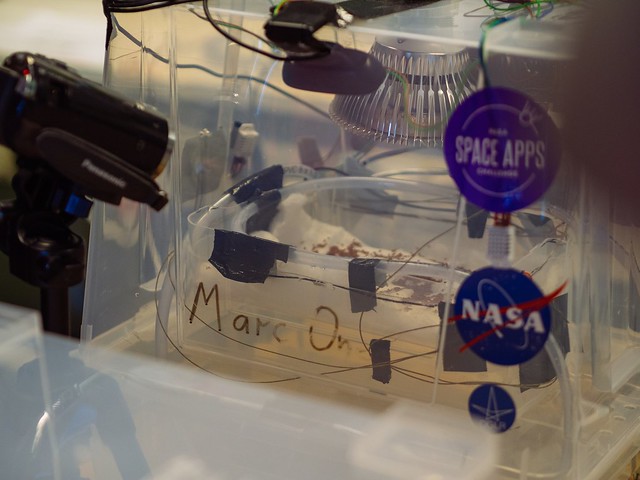
The cress.space team worked hard during the 48h hackathon to create autonomous farming, through machine learning on basis on collaborative gaming for off-earth as well as on-earth applications.
For achieving this, they set-up a demonstrator green-house that will be used as the baseline farming hardware for our game.

Voting for the People’s Choice Top 25 semi-finalists will begin Monday, May 9th at 2 p.m. Eastern and will be open through Sunday, May 15th at 2 p.m. Eastern. At this time, Space Apps will take a break to verify the votes before moving forward with the Top 5 finalists, which will be open for votes the following week.

How Voting Works:

  1. Voting will take place on a special ballot page: https://2016.spaceappschallenge.org/vote
  2. The awards page will display the Leaderboard + all the other nominees: https://2016.spaceappschallenge.org/awards
  3. Citizens who already have an account on SpaceAppsChallenge.org can vote. Others will need to sign up for an account.
    [embed]https://www.youtube.com/playlist?list=PL-lXf3kTWgqyLqUTS2V2gDnFciildD3B9[/embed]

If you like this growing community, fork our open-source code on github and start growing your own plants in your very own green-house, and please also consider voting for the team. The team that makes it to the end will receive invitations to attend a launch, most likely in September at the Kennedy Space Center.

For more information about all 3 projects teams worked on, visit the Space Apps Stuttgart 2016 location page. There is even one more runner for the global nomination to be hopefully revealed.

Thanks so much for taking part in Space Apps 2016!!

Original News on AerospaceResearch.net